

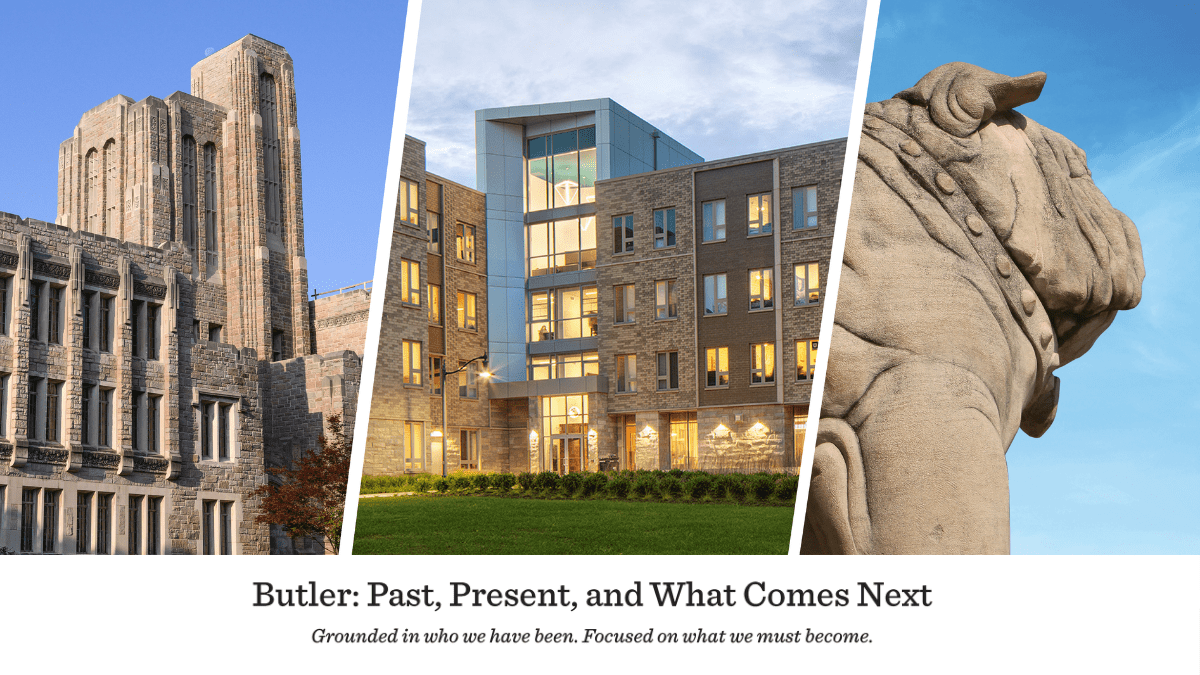
This is a working reflection on the future of higher education and what it may require of institutions like Butler. It is intentionally provocative in places and is not a plan or a set of decisions. Rather, it reflects the level of ambition I believe this moment demands. I share it in the spirit of invitation and hope it stimulates thought and conversation across our community.
Parents are right to worry.
Students are right to worry.
And those of us responsible for the future of higher education should be paying very close attention.
I worry about the career prospects of today’s undergraduates. I worry about my own daughters, now in their thirties, navigating a labor market already reshaped by automation and artificial intelligence. And I worry about my grandchildren, who will enter a world of work and citizenship that bears little resemblance to the one our universities were designed to serve.
If we believe today’s turbulence—political polarization, demographic shifts, declining public trust, and questions about value—represents the primary threat to higher education, we are underestimating what lies ahead. These pressures are real, but they are not the main event.
The deeper challenge is this. We are preparing students for a fundamentally uncertain future using structures designed for a world that no longer exists.
I spent years as an entrepreneur before entering higher education and more than three decades inside universities, including leadership roles and, since 2011, as president of Butler University. For much of that time, I did not seriously question whether the professions we were preparing students for might fundamentally change or even disappear.
That assumption was comfortable. It was also wrong.
Here is the uncomfortable truth universities must confront. We cannot credibly prepare students for a radically uncertain future if we are unwilling to rethink ourselves in equally fundamental ways.
For more than a century, universities have relied on organizing mechanisms that feel natural largely because we inherited them. Departments, majors, colleges, credit hours, and fixed pathways to a degree. These structures are not laws of nature. They are historical artifacts, optimized for a world of stable professions, linear careers, scarce knowledge, and a human monopoly over cognition.
That world no longer exists.
To be sure, higher education has not been blind to change. We have introduced certificates, experiential learning, and new forms of credentialing. But too often, these innovations are layered onto existing structures rather than prompting us to reconsider those structures themselves. We have rearranged the furniture without questioning the architecture.
Let me be direct. It is increasingly unlikely that majors, departments, and traditional colleges represent the best organizing mechanisms for learning in an AI-shaped world.
To some, this will sound heretical. To others, threatening. To a few, reckless.
Good.
Real innovation is not reassuring. It is destabilizing.
This is not an argument to sideline faculty. On the contrary, faculty must be central to imagining what comes next. Traditions such as shared governance and tenure have protected academic freedom and institutional integrity for generations. They remain important. But traditions that once enabled excellence can, if left unchanged, slow adaptation.
The issue is not whether these traditions endure. The issue is whether they evolve.
Meaningful change in any sector rarely occurs because of structures alone. It occurs because of culture. It occurs when people are willing to question assumptions, experiment, and align around outcomes rather than inputs. In a future-ready university, governance evolves alongside the world it is meant to serve, and faculty expertise becomes more fluid, more cross-boundary, and more oriented toward solving complex, real-world problems.
If we strip away the comfort of familiar structure, we are left with more important questions.
What knowledge and capabilities truly endure over a lifetime?
Which human skills grow more valuable, not less, in the presence of AI?
What does it mean to be educated when machines already outperform humans in writing, coding, and analysis?
Planned obsolescence may no longer apply only to products. It may describe entire degree programs.
Consider a simple thought experiment. What if we designed a university from scratch, unconstrained by departments, degrees, or inherited hierarchies?
What emerges would likely look very different from the institutions we currently defend.
Learning would organize around enduring human capabilities. Ethical judgment, creativity, collaboration, systems thinking, and the ability to make meaning in complexity. Students would build portfolios of capability developed across contexts and challenges. Content would still matter, but as a means rather than an end.
Education would also organize around persistent human and societal challenges. Health, climate, cities, governance, work, and human development. This would not be interdisciplinarity layered onto departments. It would be post-disciplinary by design.
Time itself would be rethought. Learning would become more flexible, modular, and lifelong, extending well beyond the traditional boundaries of a degree.
In this world, the role of faculty does not diminish. It becomes more important. As content becomes abundant and explanation increasingly automated, the distinctive value of faculty lies in judgment, context, ethical framing, mentorship, and the design of meaningful learning experiences.
This is not an argument against liberal learning, disciplinary depth, or professional preparation. These remain among the university’s greatest strengths. The mistake would be assuming that preserving those strengths requires preserving the structures that once housed them.
It does not.
The future of higher education must begin not with inputs, but with outputs. The prepared, adaptable, and ultimately successful human being.
In an AI-shaped world, every graduate will need to think and act with a degree of independence and adaptability that resembles entrepreneurship, regardless of field. They will need to integrate knowledge across domains, continue learning over a lifetime, and create value in environments that are constantly evolving.
This is the premise that must guide everything that follows. The university must organize around what human beings uniquely contribute in a world increasingly shaped by artificial intelligence. Ethical reasoning, creativity, emotional intelligence, relationship-building, trust, and the ability to integrate knowledge across domains.
Universities remain among the last dense, intentional spaces for human formation and community. That is not incidental. It is essential.
At Butler, we have long positioned ourselves as an institution willing to innovate. Our Boldly Butler strategy reflects that commitment. The question now is whether we are willing to extend that ambition to the way we organize the University itself.
The path forward is not fully defined. It will require experimentation, iteration, and the collective insight of this community.
I do not have all the answers, but I am firmly committed to the level of ambition this moment demands.
Universities face a choice. We can defend inherited models until external forces render them irrelevant. We can continue to optimize incrementally while the ground shifts beneath us. Or we can design boldly for a future that does not yet fully exist.
The institutions that lead will be those willing to ask uncomfortable questions now and to act on them.
The time to choose the bold path is not tomorrow or next year. It is now.