

Butler University’s path toward a more sustainable campus isn’t defined by a single initiative—it’s the result of steady, coordinated action across departments, classrooms, residence halls, and dining locations.
That work is now receiving national recognition.
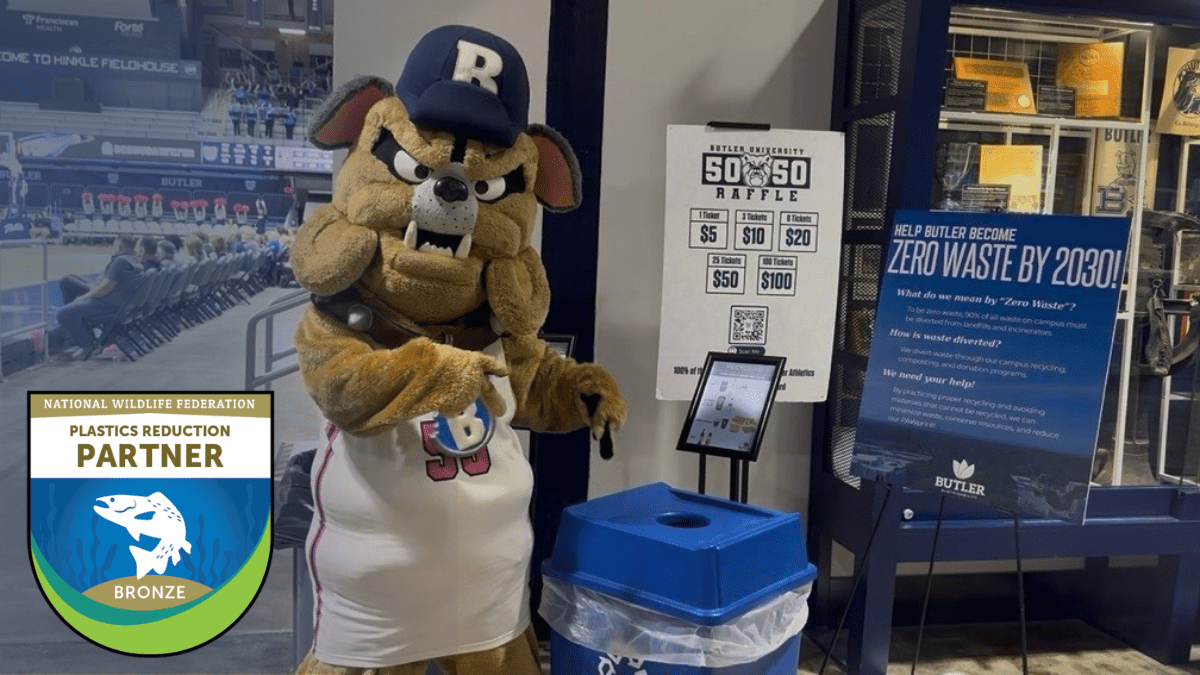
Butler has earned Bronze-level certification through the National Wildlife Federation’s Plastic Reduction Partnership, becoming the only university in Indiana to achieve this distinction. The certification acknowledges measurable progress in reducing single-use plastics and advancing a more circular, less waste-intensive campus model.
“This recognition reflects the kind of cross-campus collaboration that drives meaningful change,” the University shared in its certification materials. “It’s not one program—it’s a system of decisions, behaviors, and investments that add up over time.”
The effort begins with education—but it doesn’t stop there.
Every incoming student now completes a sustainability orientation course that includes guidance on recycling, plastics, and waste reduction. In residence halls, that education becomes visible and practical. More than 1,700 students received recycling guidance materials at move-in, reinforcing how individual behavior connects to campus-wide impact.
Student engagement extends beyond orientation. Campus programming—from interactive events to sustainability-focused tabling—helps translate awareness into everyday habits. Even youth outreach initiatives, like sustainability-themed movie nights and hands-on recycling activities, expand that impact into the broader community.
At the most basic level, Butler has also improved the clarity of its waste systems. Updated bin signage and labeling address common misconceptions—like the assumption that all plastics are recyclable—helping reduce contamination and improve diversion rates.
Beyond education, Butler has focused on infrastructure and incentives that make reducing plastic use intuitive.
Water bottle refill stations are now mapped and widely accessible across campus, encouraging a shift away from single-use bottles. Dining locations—operated in partnership with Bon Appétit Management Company—have introduced programs that reward reusable behavior, including discounts for bringing personal cups and systems that reduce reliance on disposable containers.
“Reducing plastic use at a campus scale requires both systems and culture to shift together,” Julie Lindeman, Assistant Director of Operational Sustainability, said. “We’ve focused on making the sustainable choice the easy choice—whether that’s through refill stations, clearer signage, or programs that encourage reuse. When those pieces align, you start to see real behavior change.”
In some locations, that shift is already visible: reusable to-go container programs and compostable alternatives are replacing traditional single-use plastics, while point-of-sale incentives encourage students to opt in to more sustainable choices.
The University has also rethought events and purchasing. A campus-wide Green Events framework guides departments toward lower-waste practices—from reducing giveaways to prioritizing reusable or sustainably sourced materials.
Some of the most significant progress has come from behind the scenes.
A comprehensive campus waste audit provided a data-driven baseline, identifying where plastics were entering the waste stream and where improvements could be made. That analysis has informed everything from bin placement to purchasing decisions.
Dining services have reduced reliance on single-use plastics through policy shifts—limiting items like plastic straws, introducing reusable or compostable alternatives, and piloting container programs. Meanwhile, purchasing guidelines increasingly restrict items that contribute to unnecessary plastic waste.
Even campus cleanouts and move-out periods have been reimagined. Collection drives for clothing, electronics, and other materials divert waste from landfills while reinforcing a culture of reuse.
Student-led initiatives add another layer. Programs that repurpose materials—such as transforming plastic bags into usable goods—demonstrate how sustainability can be both practical and creative.
Earning Bronze-level certification is not the end goal—it’s a benchmark.
Many institutions stall at this stage due to the complexity of reducing plastics at scale. Butler is using it as a foundation for the next phase of work, with a goal of reaching Silver-level certification within the next three years.
That path will require deeper operational shifts, expanded reuse systems, and continued alignment across academic, operational, and student life areas.
But the trajectory is clear.
Each refill station installed, each policy adjusted, each behavior changed—individually small decisions—are collectively reshaping how materials move through campus.
And in doing so, Butler is building a model for what a lower-waste university can look like in practice.