

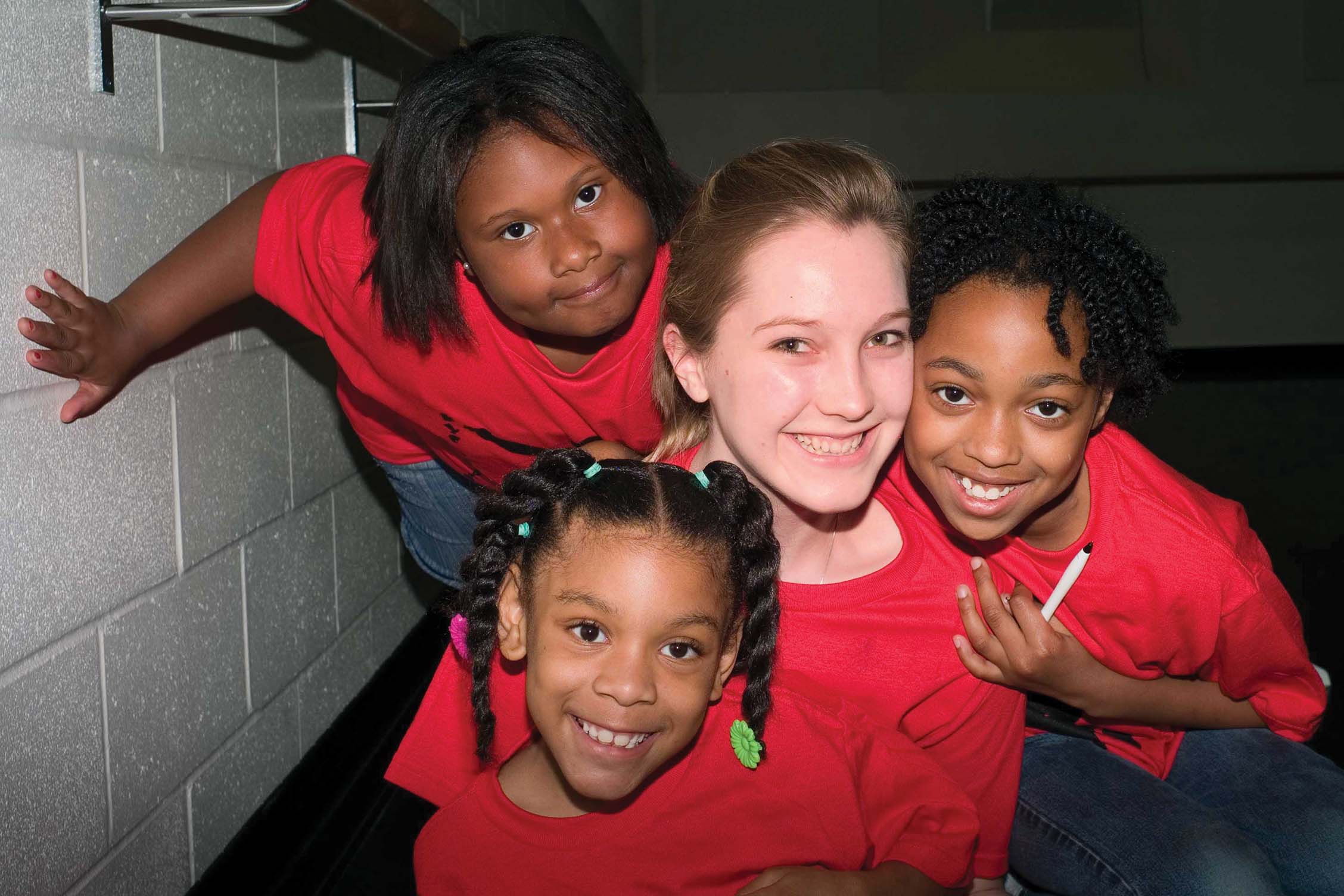
At one of Outreach Indiana’s program centers serving homeless youth and young adults in Indianapolis, Volunteer Experience Manager Jennifer Ebner watched a Butler student help a young person prepare for a job interview—brushing and styling their hair.
It was a small act of care that helped send them out with confidence, embodying the dignity the organization strives to offer at every turn.
Students connect with Outreach through the Sociology course Homelessness in America, the Ambassadors of Change pre-orientation program’s “Just Get a Job” simulation, and volunteer opportunities throughout the school year.
“While my focus is on the benefits of understanding homelessness and the systems that impact it, it’s also important that students connect personally with the people in our program,” says Ebner. “Butler students learn the power of listening more than fixing, especially for those healing from trauma, and practice those skills when they spend time with us.”
These experiences are central to Butler’s identity, evidenced by its Community Engagement Classification: a prestigious national designation that recognizes institutions committed to meaningful, reciprocal partnerships that enrich learning, strengthen communities, and advance the public good. Awarded by the Carnegie Foundation for the Advancement of Teaching, the classification was first granted to Butler in 2015 and recently reaffirmed following a comprehensive review of its partnerships and impact.
“This recognition affirms something fundamental about Butler,” Butler University President James Danko says. “Our mission calls us to educate students in ways that are connected to the world around them. Community engagement is not separate from our academic work—it is essential to how we prepare students to lead meaningful lives and contribute to the common good.”
Talk to students across campus and you’ll hear stories about the relationships they’ve built through community engagement. Some serve through Butler Ambassadors for Special Olympics or Fraternity and Sorority Life, which contributes more than 17,000 service hours and $425,000 to charities annually. Others work with organizations like the Martin Luther King Jr. Community Center, Indy’s Global Village, and Shalom Health Care Center.
“We strive to build relationships with a wide variety of community partners to reflect the diversity of our external and internal communities’ interests, identities, and passions,” says Associate Director of Student Experience and Engagement Hanako Gavia.
Gavia connects faculty, staff, students, and longstanding partners through Butler’s academic community engagement efforts. She also oversees the Indianapolis Community Requirement (ICR), which ensures every student completes a meaningful, academically grounded community engagement experience before graduation.
“We work to really listen to what our partners are saying and find where we fit,” Gavia says. “Sometimes it’s service-based activities like a book drive or tutoring, sometimes it’s engagement-based like attending partner events or inviting them in to teach us about their experiences, and sometimes it’s a formal agreement to accomplish a shared goal.”
Senior Ireland Crabtree, a Criminology and Psychology major, completed her ICR at Big Brothers Big Sisters. Now, she works as their Advocate for Community Engagement (ACE), helping Gavia connect community sites with Butler students and faculty.
“The feedback I receive most from other students at the end of their ICR is that they’ll miss seeing their mentee every week, and mentees say the same thing about their Butler mentors,” Crabtree says.
One student she mentored started the program withdrawn and disengaged. But by the end of the semester, he stepped in as a vibrant leader during activities.
“Seeing him smile and get more involved showed me our contributions to the Indianapolis community are extremely important and can mean more to others than we may think,” she says. “Academically, it was great to be able to connect what I was learning in class to hands-on experiences.”
Gavia says that, over time, students are often the ones most transformed. She sees them begin to “decenter themselves and think of themselves as part of a whole network,” bringing a deeper sense of community into their learning and professional development.
Director of Campus and Community Development Karissa Hulse sees this mindset echoed in Butler’s broader initiatives across Midtown Indianapolis, where partnerships seek to invest in strengthened connection, accessibility, and shared prosperity.
“A strong sense of place shapes how we engage, contribute, and have fun,” says Hulse. “At Butler, this means understanding our role in Midtown Indianapolis—as neighbors and as partners—and uplifting the experience of community-engaged learning and the cultural vitality of our city.”