

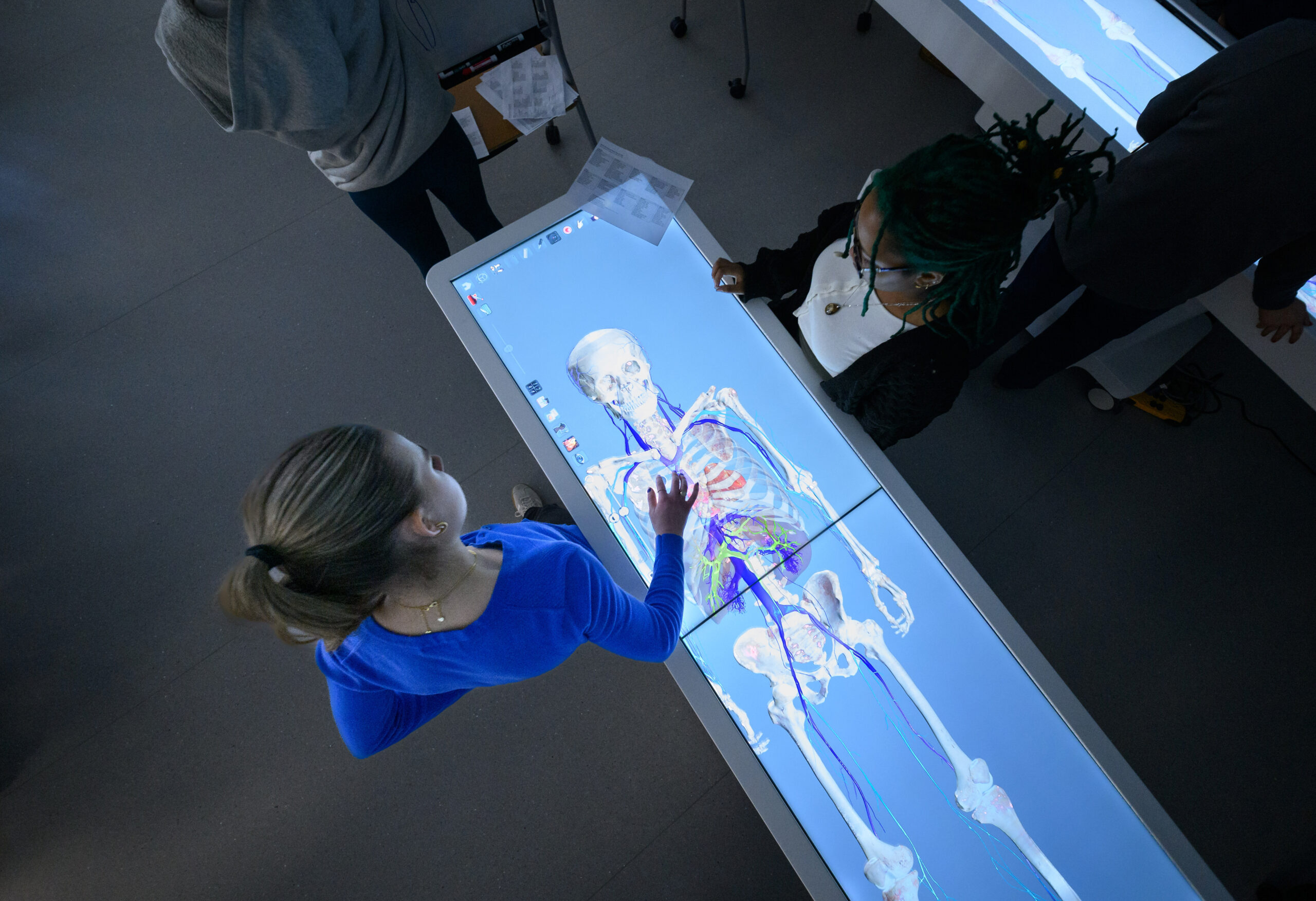
Artificial intelligence can analyze more data, identify patterns faster, and give pharmaceutical scientists new ways to search for promising treatments. But it still takes a scientist to know which questions are worth asking.
Butler University is preparing those scientists.
The University’s Bachelor of Science in Pharmaceutical Sciences (BSPS) combines foundational science, research, professional experience, and advanced AI and data skills to prepare students for a pharmaceutical and life sciences industry that is changing quickly.
“We’re making it relevant to the moment we are in,” said Marcos De Oliveira, Chair of Butler’s Department of Pharmaceutical Sciences. “It is the AI moment.”
For De Oliveira, that doesn’t mean replacing foundational science with technology. It means giving students more powerful ways to put that science to work.
Students begin with chemistry, biology, mathematics, and pharmaceutical science before learning to work with increasingly complex forms of information, including biological, chemical, patient, and business data. Their studies reach into areas including bioinformatics, data analytics, regulatory science, and artificial intelligence.
The combination reflects what De Oliveira and his colleagues heard when they began asking graduates and industry professionals how pharmaceutical science was changing. One message kept surfacing: Data was becoming central to the work.
The department began exploring what that could mean for undergraduate education. Several years before launching BSPS, Butler Pharmaceutical Sciences faculty were already creating experiences that challenged students to combine scientific knowledge with emerging computational and data skills. Those experiences helped demonstrate what students could accomplish when traditional scientific disciplines and new technologies came together.
The BSPS program builds on that foundation with an undergraduate degree designed for what comes next.
“AI accelerates everything,” De Oliveira said. “How about accelerating education?”
At Butler, the answer is not simply to introduce advanced technology earlier. The sequence matters.
Students first learn the science. Then they practice it through research. They develop the communication and professional skills needed to enter the workplace and prepare for an extended professional experience. They then bring that experience back to Butler, where greater context and maturity can inform the advanced AI and data work that follows.
“With the co-op experience, they will gain maturity,” De Oliveira said. “That means we can press on the accelerator.”
Research is an important part of that progression. Butler Pharmaceutical Sciences faculty and students are already working together on complex research questions. A recent collaboration between Associate Professor Caleb Class and PharmD student Victoria Gaertig ’27, for example, contributed to research examining gene-expression patterns associated with response to the antidepressant fluoxetine. Their work was published in Molecular Psychiatry.
Experiences like that demonstrate the research environment BSPS students are entering: one in which students can move from learning established science to participating in the process of creating new knowledge.
That same progression extends beyond the laboratory. During their first year, BSPS students meet professionals working in the field, explore potential careers, and begin learning how to articulate their own professional interests. De Oliveira even has students identify a potential job and write a cover letter explaining why they want it.
That exercise happens years before graduation by design.
“The first part of the first two years is how to discover their professional identity,” De Oliveira said. “Who are they in this realm?”
The answer can lead in several directions. The program is designed to prepare students for four broad pathways: careers in the pharmaceutical and biotechnology industries, health professions, regulatory careers, and graduate education.
Whichever direction they choose, experience is intended to play an important role in preparing them for it.
Butler is developing a co-op model that would give BSPS students an extended opportunity to work in a role connected to their studies. Rather than fitting professional experience around a full academic schedule, students would have time to become part of an organization, work alongside professionals in the field, and apply what they have learned to real problems.
Indianapolis creates a natural environment for those connections. Its pharmaceutical, biotechnology, healthcare, and life sciences community gives Butler students access to professionals and organizations working across the field.
For De Oliveira, however, the value of those experiences extends beyond career preparation. What students encounter outside the classroom changes what becomes possible when they return to it.
A student who has participated in research or worked in a professional environment brings different questions, greater context, and a clearer understanding of how scientific knowledge gets used. Faculty can build on that experience and ask more of them.
That is why the program’s combination of rigorous science, emerging technology, and experiential learning also depends on something distinctly human: close faculty mentorship.
“We have to be next to them. We have to be observant,” De Oliveira said.
Faculty mentorship and advising, then, aren’t support systems operating around the edges of the program. They are part of how the education works. Students are challenged to develop across disciplines while also discovering where their individual strengths and interests might take them.
It is an approach built around a future that no curriculum can completely predict.
The technology today’s students will use throughout their careers will continue to change. New scientific questions will emerge. And some of the careers they eventually pursue may look considerably different by the time they reach the height of their professions.
What shouldn’t change is the need for scientists who understand the fundamentals, can recognize a problem worth solving, and know how to turn increasingly sophisticated information into better decisions for human health.
AI may help them get there faster.
“It can’t do it without the human element,” De Oliveira said.