

On March 14, 2026, Butler University opens its campus to Midtown for a community-wide electronic recycling event—advancing its 2030 zero-waste commitment and reinforcing its role as an anchor institution in Indianapolis.
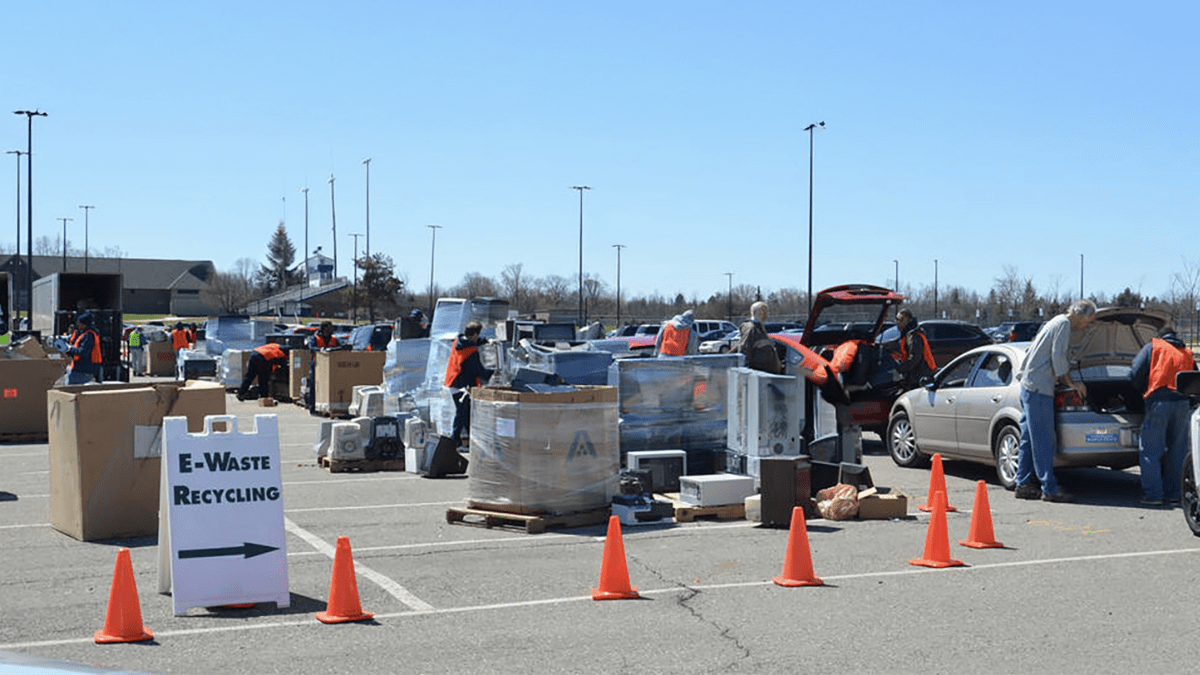
From 9:00 AM-noon at Hinkle Fieldhouse, Butler will host its first community-wide Electronic Recycling Day in partnership with Technology Recyclers. The drive-through event will allow neighbors across Midtown and Indianapolis to responsibly dispose of outdated electronics—items that cannot legally be thrown away in Indiana, yet are often difficult to recycle.
Electronic waste accounts for only two percent of America’s trash but up to 70 percent of its toxic pollutants. Devices contain hazardous materials that can leach into soil and groundwater if improperly discarded. At the same time, Americans now own an estimated 24 electronic devices per household, and recycling rates have declined in recent years.
“This is about making responsible choices accessible,” says Julie Lindeman, Assistant Director of Operational Sustainability. “Electronic waste is difficult to recycle properly, and access isn’t always consistent. As a university rooted in Midtown, we’re in a position to help meet that need.”
That decision reflects Butler’s broader commitment to strengthening long-term operational sustainability and advancing its role as a steady, engaged presence in its surrounding neighborhoods. As an anchor institution, Butler does more than educate students—it convenes partners, shares infrastructure, and looks for ways its resources can create broader benefit.
The March 14 event builds on progress already underway. Over the past year, Sustainability, IT, and Operations, have worked to improve how electronic and battery recycling functions internally. Seventeen battery recycling bins now serve buildings across campus. IT has expanded the types of electronics accepted. What once operated across separate systems has become more coordinated and intentional. And now, Sustainability, IT, Operations, and Athletics, BUPD, Marketing, and other campus partners have come together to plan the upcoming drive.
“This has been a campus-wide collaboration,” Lindeman says. “When we align around a shared goal, we can create systems that work better—for campus and for community.”
Participants will remain in their vehicles while Technology Recyclers employees and volunteers unload and sort electronics. Most items with a cord or battery are accepted, including computers, printers, cables, stereos, and small appliances. Televisions and monitors carry a $20 fee; devices containing Freon are $30, with a discount available for Butler students and employees.
Technology Recyclers, an Indiana veteran-owned company, brings 14 years of certified experience to the partnership. The company is R2v3-, RIOS-, and NAID-certified, and its IDEM-registered credentials represent the highest standards in environmental responsibility and secure data destruction.
“We guarantee that nothing brought to us ends up in a landfill,” says Dale Needleman, Founder and Partner at Technology Recyclers. “Electronics contain hazardous materials. If they’re disposed of improperly, those chemicals can contaminate the earth and water table. Certified recycling protects the environment and protects your data.”
Each item is tracked, triaged, dismantled, separated, and either shredded or wiped to Department of Defense standards. The company complies with HIPAA, FERPA, DOD, and NIST 800-88 requirements, ensuring secure destruction of sensitive information. Recovered materials—including copper, silver, and gold—are resold for remanufacturing or reuse. Not a single pound collected ends up in a landfill.
For Butler, this event is one step within a larger commitment. The University has set a goal of achieving zero waste by 2030. A recent campus waste audit identified more than 60 recommendations to reduce landfill impact. Composting programs in Residential College and Atherton Union are already diverting food waste, and updated signage and education efforts continue reshaping recycling habits across campus.
Electronic recycling is another tangible move forward.
As an anchor in Midtown, Butler is uniquely positioned to connect campus systems with community needs. When infrastructure, partnerships, and shared purpose align, small actions scale.
On March 14, that alignment is straightforward. Cars will pull into a familiar campus lot. Volunteers will unload outdated devices. Old technology will be moved through a secure, certified, landfill-free process rather than into the trash.
It is a practical step. A collaborative step. And another example of how Butler continues extending its zero-waste vision beyond campus.
A full list of electronics accepted can be found here. For more information, please contact sustainability@butler.edu.