

Guided by faculty mentors, Butler students turn real research experience into real scientific contributions
When pharmacy student Victoria Gaertig ’27 first emailed Assistant Professor Dr. Caleb Class, she wasn’t expecting to help publish research in one of psychiatry’s leading journals. She simply wanted to try something new.
“I had no clue how to code,” she said. “But I was curious, and I wanted to challenge myself. Once I reached out, everything opened up from there.”
That first step led her into a multi-year research collaboration—one that recently resulted in a publication in Molecular Psychiatry, a top journal in the field.
And it all started with one conversation and the willingness to learn.
Dr. Class’s research centers on a complex and pressing challenge: understanding why people respond differently to the same antidepressant. His team brings together genomic datasets from across the world to uncover patterns that could one day guide personalized treatment.
“There are hundreds of thousands of these datasets available,” he explained. “Our goal is to bring them together in systematic ways to understand what’s actually happening in the body.”
The project began as a Butler Summer Institute proposal from student Paige Cowden ’23, who suggested examining the response to antidepressant treatment. From there, the work expanded into a multi-year systematic review involving 20 datasets and contributions from seven undergraduate researchers across pharmacy, biology, data science, and computer science.
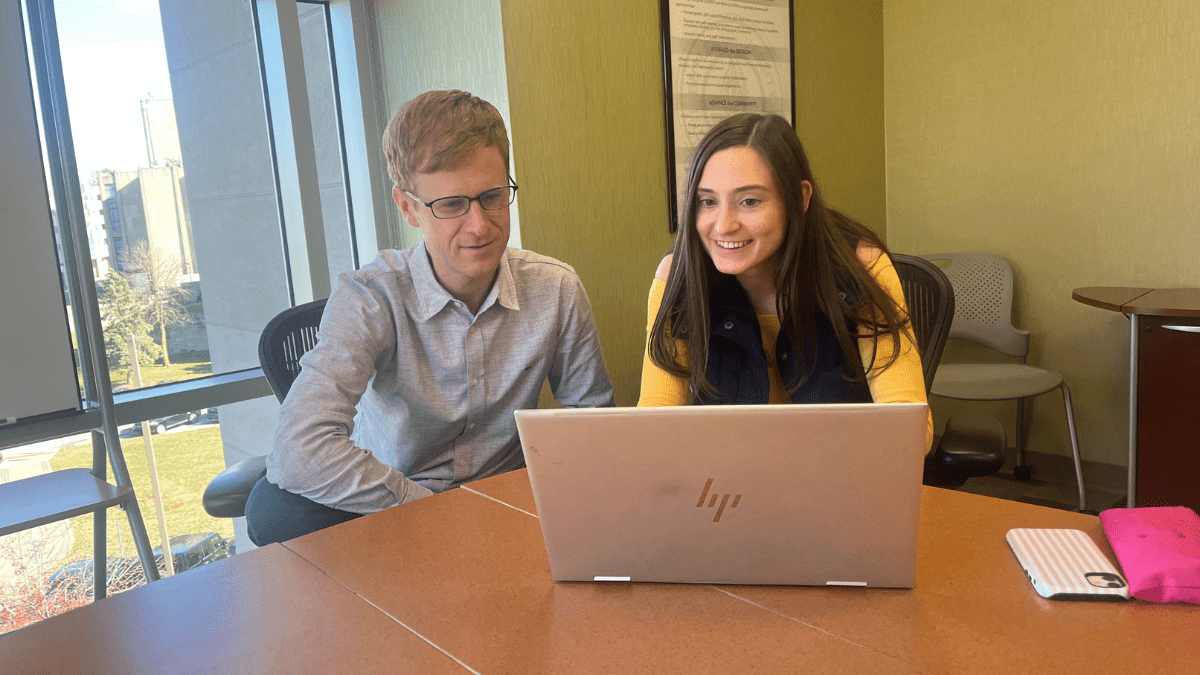
Victoria joined the project during her second year on campus. Each week, she met individually with Dr. Class—learning RStudio, cleaning complex datasets, creating visualizations, and documenting her analysis. “Learning something completely new was the biggest takeaway,” she said. “It shaped how I think and what I want to do next.”
Her work, along with that of her peers, became part of the published paper’s analysis.
For students in Dr. Class’s lab, research is never a one-size-fits-all experience. He tailors each project to a student’s background, interests, and goals, especially for those who come in with no coding or data science experience.
“The first time students go through an analysis, they might not be able to explain it,” he said. “But then something clicks. I’ve seen students make incredible jumps in their understanding.”
Mentorship extends beyond his own courses. Butler’s collaborative culture allows students to work across departments, connecting them with projects that match their scientific and professional interests.
“Students get direct mentorship from faculty—and not just their own faculty,” Dr. Class said. “We’re really able to match them with the experiences that will help them move forward.”
It’s this model of personalized support and hands-on inquiry that contributes to Butler’s No. 40 national ranking in Undergraduate Research.
The team’s work revealed that certain inflammation-related gene patterns may help distinguish between people who respond well to fluoxetine (Prozac) and those who do not—insight that could help other scientists advance precision treatment models.
Because the project was a systematic review, the team didn’t begin with a hypothesis. They simply followed what the data revealed.
“Whatever the results are, the results are,” Dr. Class said. “Our hope is that other researchers take what they find interesting in our work and build on it.”
It’s a rare opportunity for undergraduates to contribute meaningfully to research of this caliber—and a powerful example of how experiential learning prepares students for the next stage of their academic or professional paths.
Four years after starting the project, Victoria is still working with Dr. Class, now helping analyze journal articles and preparing a poster presentation for an upcoming conference.
She credits that growth to the mentorship she received and the confidence she built through hands-on work.
“It was nice having that one-on-one mentorship—having someone who believes you can learn something new,” she said. “I’ve gained skills that will help me for the rest of my career.”
Her advice for students considering research?
“Just reach out. Even if you have an interest or a little inkling,” she said. “You never know where it will take you.”
For Dr. Class, watching students evolve as researchers is one of the best parts of the work.
“Please don’t be intimidated,” he tells students. “Faculty want to talk with you about your interests. Our goal is to help you find the right place to explore them.”
And for students like Victoria, the experience proves that learning can go far beyond the classroom—sometimes all the way to publication.