

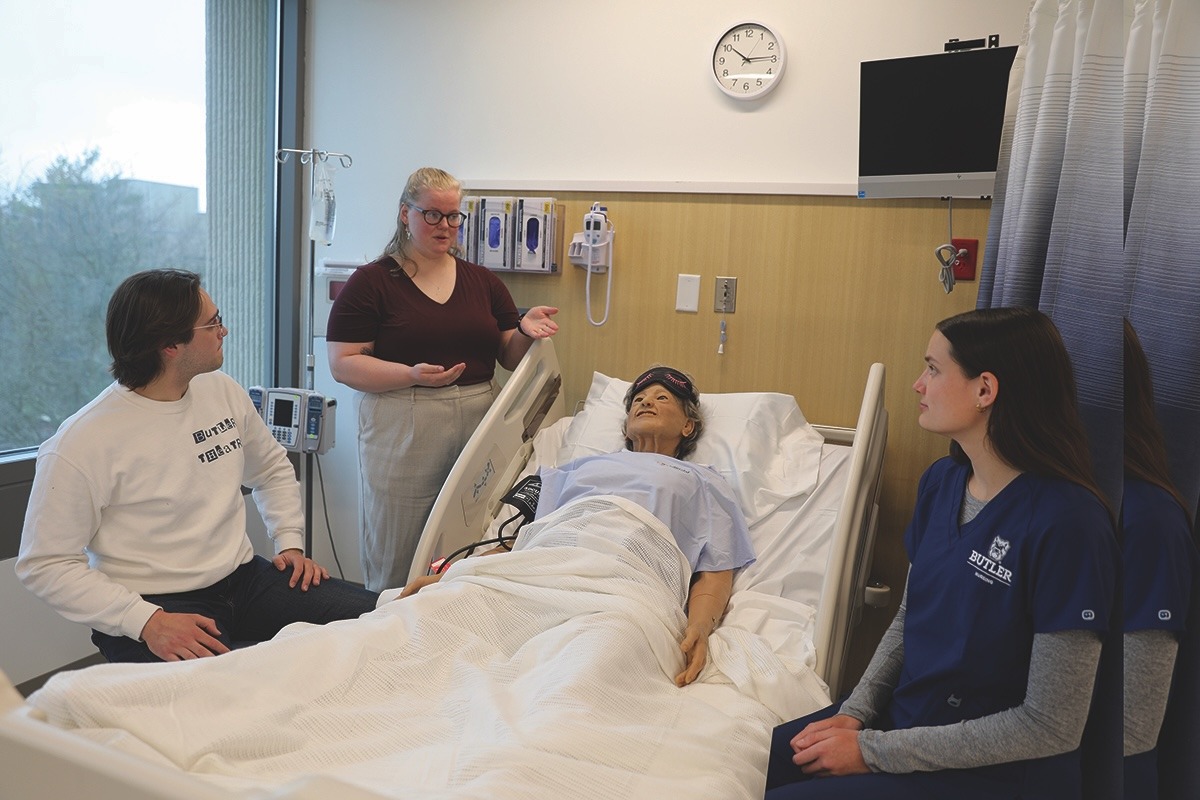
In cities with major medical schools and teaching hospitals— like Indianapolis—professional actors are increasingly stepping into exam rooms instead of rehearsal halls. When they’re not on stage or on set, many are working as simulated patients, portraying individuals with specific symptoms, histories, and emotions so future medical professionals can practice real-world care.
“Patient simulation sounds funny to people not in the business,” says Diane Timmerman, Theatre Department Chair. “But it’s literally one of the hottest day jobs for actors in the country right now and can pay very well.”
Patient simulation falls under the umbrella of applied theatre, a broad term for theatrical techniques used outside traditional performance spaces. It can include work in prisons, museum theatre, and social service agencies.
The idea of incorporating patient simulation at Butler was sparked by a conversation Pharmacy Professor Julie Koehler had with one of her daughters’ theatre teachers, who said, “Theatre teaches empathy.” As a healthcare professional, that statement immediately captured her attention. “It became clear to me that the empathy cultivated through theatre could be incredibly powerful in healthcare education,” says Koehler.
In spring 2023, Timmerman and Koehler began pairing Theatre students with Pharmacy students in simulated patient scenarios in Koehler’s Self-Care and Health Promotion course.
Both sides loved the experience. “It’s a real opportunity for a science student to connect with a theatre student, each in their own expertise,” Timmerman says. “We’re always collaborating in theatre, but we’re not always collaborating with the sciences.”
Koehler agrees: “Meaningful innovation often happens at the intersection of disciplines, and it’s wonderful to see our disciplines joining together to support and teach one another.”
Now, Timmerman is determined to expand the effort and formalize it through a Patient Simulation Certificate program.
In January, Sarah Heider ’17, an actress and Patient Simulation Specialist at IU Health, led a two-hour workshop for Butler Theatre students. Heider began her career as an actor in patient simulation and now oversees others in the field.
Nursing student Reese McKee ’29 explains how interacting with a trained actor helped her understand how patients process news.
“It challenged me to adjust my communication in real time. This is something you can’t fully capture in a classroom setting, making it one of the most practical experiences I have had.”
The proposed certificate would require students to attend workshops led by Heider and gain hands-on experience across Nursing, Pharmacy, Physician Assistant, and Respiratory Therapy programs, with an aim at integrating Social Work as well.
“If a student could walk out of here with a credential in patient simulation—hours of experience, documented training— that’s powerful,” she says.
Heider confirms, “If someone came into my office with that certification and experience on their résumé, I would hire them in a second.”
Just as important, the partnership reflects a broader philosophy about theatre education. “Some people think it’s Broadway and feature films, or nothing,” Timmerman says. “But there’s a whole world of theatre where people make a really good living and have a creatively rich life.”