

Healthcare has never stood still.
Over the last century, new discoveries, new technologies, and new models of care have continually transformed how healthcare is delivered. Today, the pace of change is accelerating. Patients are living longer. Healthcare needs are becoming more complex. And employers are increasingly seeking professionals who can adapt, collaborate, and lead in rapidly evolving environments.
At Butler University, that reality is helping shape the next chapter of healthcare education.
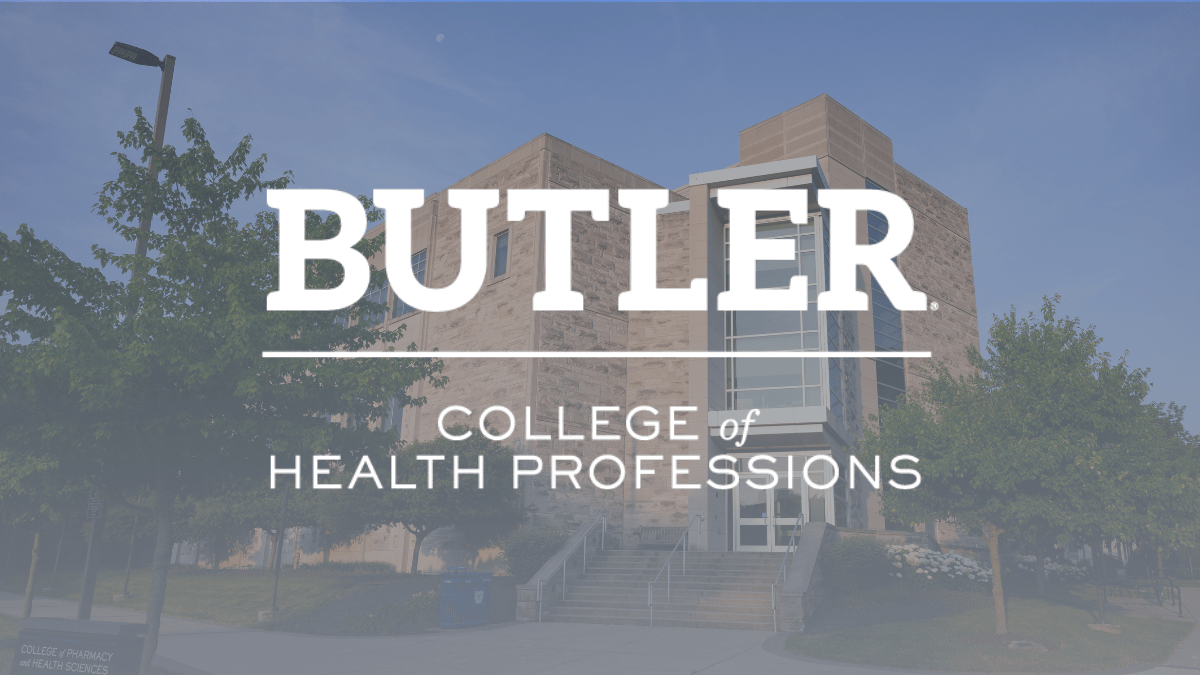
Beginning June 1, the College of Pharmacy and Health Sciences became the College of Health Professions—a change that reflects not only how healthcare is evolving, but how Butler is preparing students to lead within it.
The decision is not about moving away from Pharmacy. In many ways, it is possible because of the Pharmacy program.
For more than a century, Butler’s healthcare story has been rooted in excellence, beginning with the founding of the Indianapolis College of Pharmacy in 1904 and continuing through its merger with Butler University in 1945. Since then, generations of graduates have carried their Butler education into hospitals, community pharmacies, research laboratories, healthcare systems, and organizations across Indiana and beyond.
Their work helped establish Butler as a trusted leader in healthcare education. They built a reputation for excellence, compassion, innovation, and service that continues to define the College today.
Now, that foundation is creating new possibilities.
“What excites me most is the opportunity in front of us,” said Dr. Robert Soltis ’87, Dean of the College and a Butler Pharmacy graduate. “Healthcare needs talented people who are prepared to think broadly, work collaboratively, and lead through change. The College of Health Professions allows us to build on our strengths while creating new opportunities for students to make a difference in the lives of others.”
The need has never been greater.
Healthcare organizations across Indiana and the nation continue to face workforce shortages while caring for an aging population with increasingly complex needs. At the same time, advances in medicine, technology, and artificial intelligence are reshaping nearly every aspect of patient care.
Success in that environment requires more than technical expertise. It requires professionals who can solve problems, communicate effectively, and understand how their work connects to the larger healthcare ecosystem.
Imagine a patient in a rural Indiana community managing diabetes, heart disease, and mobility challenges. Their care may involve a pharmacist reviewing medications, a nurse coordinating treatment plans, a physician assistant providing ongoing care, a social worker helping connect them to community resources, and technology that allows providers to monitor health remotely between appointments.
No single profession can address every challenge that patient faces. The best outcomes depend on professionals who understand not only their own expertise, but how to work alongside others in service of the patient.
That reality is becoming increasingly common across healthcare—and it is helping shape how Butler prepares the next generation of healthcare professionals.
“Healthcare is facing some of the most significant challenges in its history—from workforce shortages and growing demand for care to questions about access, affordability, and the role of emerging technologies like artificial intelligence,” Soltis said. “But those challenges also create opportunities for innovation and leadership. We have a responsibility to prepare graduates who can think broadly, work collaboratively, and serve their communities in meaningful ways. That’s ultimately what this next chapter is about: preparing healthcare professionals who will help care for future generations.”
That responsibility is helping guide Butler’s vision.
In recent years, the University has expanded its healthcare offerings, including the launch of its Bachelor of Science in Nursing program that welcomed its first cohort in fall 2025. But the broader goal extends beyond adding programs. It is about preparing graduates who understand the interconnected nature of healthcare and who are equipped to improve outcomes for patients, organizations, and communities.
“The most meaningful healthcare breakthroughs happen when talented people bring different perspectives together around a common purpose,” Soltis said. “We want our students to understand not only their own discipline, but how they contribute to something larger. That’s what modern healthcare requires, and it’s what our graduates will be asked to do throughout their careers.”
The College’s ability to pursue that vision stems from the strength of the programs already in place.
Butler’s Doctor of Pharmacy program ranks among the nation’s top private Pharmacy schools. Graduates consistently achieve strong outcomes, and students benefit from immersive experiences that connect classroom learning with the realities of a changing profession.
This spring, students participated in Butler’s inaugural Boston Pharmacy Trek, visiting pharmaceutical and biotechnology organizations, connecting with alumni, and exploring career pathways across the industry. Experiences like these help students understand not only where healthcare is today, but where it is headed.
That future-focused approach reflects a belief that has long defined a Butler education: graduates should leave campus prepared not simply for their first job, but for a lifetime of learning, leadership, and impact.
Dr. Jay Howard, Interim Provost, sees the transition to the College of Health Professions as a reflection of that commitment.
“Higher education has a responsibility to anticipate where society is headed and prepare students accordingly,” Howard said. “The College of Health Professions reflects Butler’s commitment to staying ahead of change while remaining grounded in the values that have always defined this institution. It’s an example of how we honor our history by preparing for the future.”
For Soltis, the transition is both exciting and deeply personal.
As a Butler Pharmacy graduate who returned to his alma mater as Dean, he sees the future of the College as an extension of the same mission that first brought him to campus decades ago: preparing graduates whose knowledge, compassion, and leadership improve the lives of others.
“Our history gives us tremendous confidence about the future,” Soltis said. “Generations of Butler graduates have built a reputation for excellence, compassion, and service. The College of Health Professions allows us to carry those values forward while expanding our ability to serve students, healthcare organizations, and communities.”
The name on the College changed on June 1, 2026. Its purpose did not.
For more than a century, Butler has prepared healthcare professionals to improve lives and strengthen communities. The College of Health Professions represents the next chapter in that work—one built on the accomplishments of generations of Pharmacy graduates and designed to prepare the adaptable, collaborative leaders healthcare will need in the decades ahead.
The legacy remains. The opportunity grows.