

When Eric Bedrosian ’26 arrived at the Lacy School of Business as a first-year student in the fall of 2022, he brought with him more than memories of high school DECA competitions. He brought an idea, and a challenge.
“I told Dean Craig Caldwell, half-jokingly, that if I came to Butler University, I wanted to start a DECA chapter,” Bedrosian, 2022-2024 Butler DECA president and recent Butler graduate, says. “He said, ‘Alright – let’s do it.’ And he meant it.”
Less than four years later, that idea has grown into the largest collegiate DECA chapter in the world, placing Butler University at the center of a global organization that prepares emerging leaders and entrepreneurs for careers in marketing, finance, hospitality, and management through competition, leadership, and real-world experience.
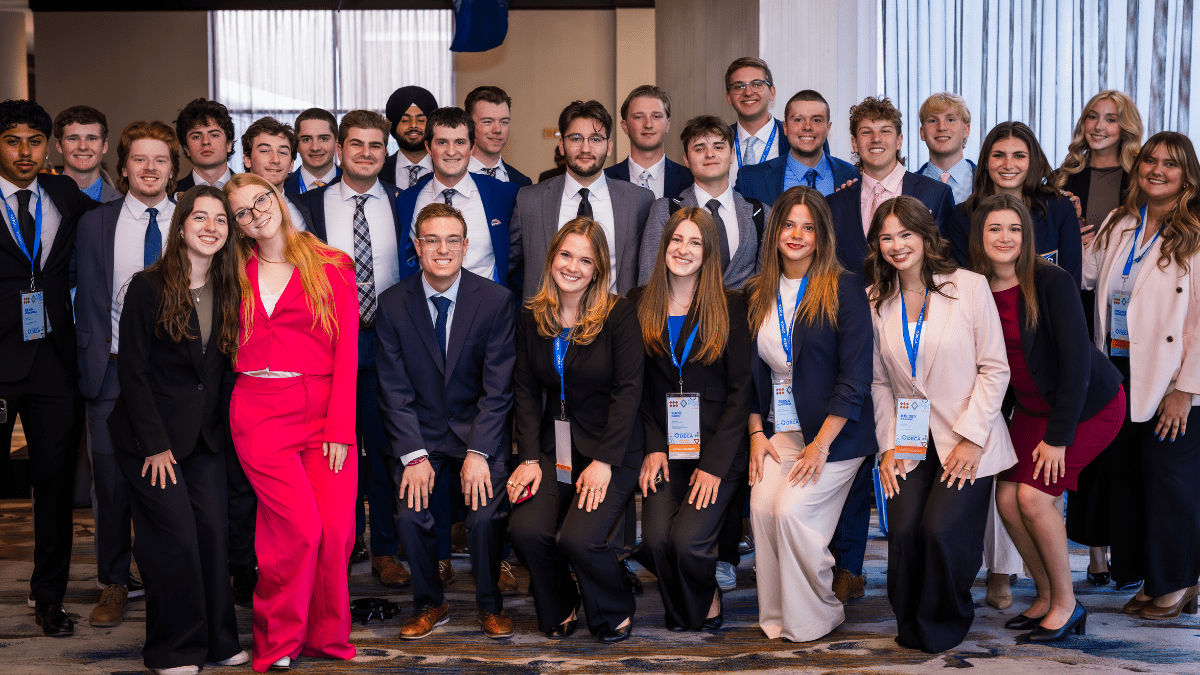
Founded in 2022, Butler DECA has expanded to more than 275 members, drawing students from across disciplines and producing dozens of international finalists and winners each year at the state and International Career Development Conference (ICDC) levels.
But for the students and faculty who built it, the milestone represents far more than size.
Butler DECA began with just seven students – many recruited from a first-year residence hall floor – and no formal roadmap. At the time, Butler was the first collegiate DECA chapter in Indiana, navigating growth largely on its own following COVID-19 disruptions that left many collegiate chapters inactive nationwide.
“There was never a blueprint,” Bedrosian says. “We weren’t trying to copy other schools. We asked a different question: What does Butler need?”
That mindset shaped the chapter’s identity early. Rather than centering solely on competition, Butler DECA intentionally developed competitive and non-competitive membership pathways, creating space for students interested in leadership development, professional exposure, and community – whether or not they ever stepped on a competition stage.
“We don’t call ourselves a business club,” Jack Paulson, Butler DECA’s president and senior Strategic Communication and Spanish major, says. “We’re a professional development organization. Anybody can join, and if you put the time and effort in, you’ll grow – regardless of your major.”
That approach helped fuel rapid growth and broadened Butler DECA’s reach well beyond the Lacy School of Business.
At its core, collegiate DECA bridges classroom learning with real-world application. Through conferences, case competitions, workshops, and mentorship, students are challenged to think critically, communicate effectively, and make decisions under pressure.
For competitive members, DECA’s Individual and Team Case Study events place students in realistic business scenarios with limited preparation time. Individuals or teams assume roles such as consultant, manager, entrepreneur, or industry specialist and present solutions to business professionals serving as judges. In Prepared Business Presentation events, students develop written prospectuses in advance and deliver presentations to professionals with experience in their field, often receiving detailed feedback.
“Those moments teach you how to walk into a room, tell a story, and persuade someone who knows their industry”, Tim Nelson, 2025-2026 Butler DECA’s president and senior finance and mathematics major, says. “Those skills apply no matter what career you’re going into.”
Beyond competition, Butler DECA emphasizes leadership and professional growth through experiences that extend well beyond campus. Those experiences have included national and international travel to conferences and competitions in cities such as Austin, Louisville, and San Francisco, as well as notable collaborations beyond DECA’s traditional programming. The chapter partnered with Butler’s Private Venture Association to host IndyCar 500 winner Alex Palou, expanding DECA’s reach across disciplines and student organizations.
For many members, DECA’s impact happens entirely outside the competition space – through speaker events, leadership initiatives, industry visits, mentorship, and cross-campus collaborations that prioritize skill-building and meaningful engagement over trophies.
Today, Butler DECA includes students from across campus, including students majoring in Biology, Chemistry, Strategic Communications, and Health Sciences. Executive leadership reflects that diversity, reinforcing the organization’s emphasis on transferable skills.
“As a STEM major, DECA gave me skills I don’t always get in the classroom – how to communicate clearly, tell a story, and think on your feet,” Kelsey Babinac, Butler DECA’s vice president and junior Chemistry major, said. “Those are skills you need in any field.”
Nelson says that emphasis on leadership is what keeps students engaged.
“DECA is a leadership organization first,” Nelson added. “The business skills matter, but communication, confidence, and decision-making under pressure – those translate anywhere.”
That philosophy extends to how the chapter operates. Students lead everything, from executive-level speaker series and industry tours across Indianapolis to competition logistics and mentorship pairings, while faculty advisors intentionally stay in a support role.
Recently, Butler DECA has moved under Butler Entrepreneurship, aligning the organization more closely with the University’s emphasis on cultivating an entrepreneurial mindset and building transferable skills such as innovation, adaptability, and leadership. The chapter is supported by three faculty advisors from the Lacy School of Business – Mark Donner, Nick Smarrelli, and Tanya Carson – who provide strategic guidance while preserving DECA’s student-led model.
“This chapter is student-run, student-led, and student-operated,” Donner said. “You create a vacuum of responsibility, and the students step into it.”
As membership grew, competitive success followed. Butler DECA has advanced from third-largest collegiate chapter, to second-largest, to largest in the world in just four years, while simultaneously building a reputation for performance at ICDC.
“Winning your first glass at ICDC was a turning point,” Kate Parisi, Butler DECA’s vice president of career development and senior Finance and Marketing major, said. “You could feel the belief shift, from being excited just to be there to knowing we truly belonged among the best.”
Since then, Butler DECA has recorded:
- Five top-three finishes at ICDC over the past two years
- 25-30 top-10 international placements over three years
- Finalists represented across nearly every competitive discipline.
“Hearing ‘Butler’ called again and again at ICDC was surreal,” Parisi said. “That’s when it really hit us how far this chapter had come: from a small group to something recognized on a global stage.”
Yet leaders are quick to emphasize that competition has never been the sole measure of success.
“If the only reason people show up is to win, you won’t last,” Blake Schnackenberg, 2024-2025 DECA president and recent Butler graduate, said. “We wanted members, competitive or not, to leave with experiences they could talk about, learn from, and carry forward.”
Being recognized as the largest collegiate DECA chapter in the world has shifted recruitment, visibility, and opportunity – but leaders say the focus now is on sustainability.
“The goal moving forward is quality assurance,” Bedrosian said. “Protecting the culture we’ve built and making sure every member finds real value here.”
“Yes, the competitions are exciting, but it’s the people and shared experiences that keep students coming back year after year,” Parisi added.
For Donner, the success of Butler DECA is ultimately found in small moments.
“Seeing students take ownership – that’s what I’m most proud of,” he said. “That’s when you realize you’ve built something that’s going to last.”
From a dorm-room idea to a global distinction, Butler DECA’s rise reflects what’s possible when students are trusted to lead, and when leadership is defined not by titles or trophies, but by impact.