

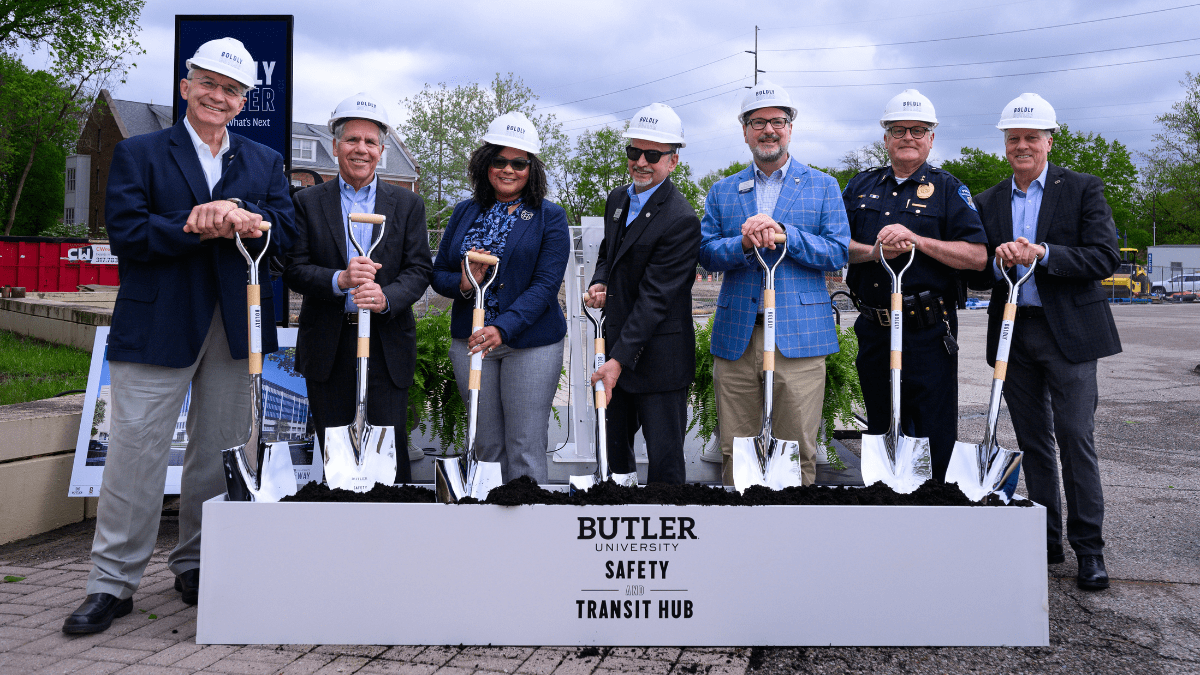
With clouds clearing and the sun making a late cameo appearance, Butler University officially broke ground on its new Safety and Transit Hub—marking a significant step forward in the institution’s long-term Gateway Project strategy and its commitment to strengthening both campus operations and community connectivity.
Faculty, staff, trustees, construction partners, and community members gathered on South Campus to celebrate construction, which began in February 2026. The seven-story, 239,322-square-foot facility will include a 664-space parking garage with electric vehicle charging stations, dedicated retail space, and a centralized headquarters for the Butler University Police Department (BUPD).
The Hub is designed to meet LEED Gold and ParkSmart standards, and is the first facility on Butler’s campus with solar panels. Indianapolis-based CSO Architects is the firm leading the design of the project. Construction is expected to be completed in July 2027.
Alan Finn, Executive Vice President and Chief Operating Officer, opened the ceremony by welcoming attendees and recognizing the broad coalition of partners who helped bring the project to life.
“Today marks an important transition—from vision and planning to execution,” Finn said. “The Safety and Transit Hub demonstrates Butler’s commitment to thoughtful growth and to creating infrastructure that serves not only our campus, but also the broader community around us.”
President James Danko positioned the project within Butler’s broader strategic direction, emphasizing the role of campus design in shaping the student and visitor experience.
“Today is about progress—but it’s also about purpose,” Danko said. “The way a campus is designed shapes how people move, how they connect, and how they experience a sense of belonging.”
He connected the Safety and Transit Hub to Butler’s Gateway Strategy, a long-term effort to strengthen connections between campus and the surrounding community.
“It creates a clear and welcoming point of arrival—a front door to campus that reflects the pride we have in Butler and the experience we want for every student, neighbor, and visitor,” Danko said.
Danko also pointed to the broader momentum across campus, noting that the project builds on recent investments including Clowes Memorial Hall, the Whitehill Ballroom, Holcomb Gardens, and Founder’s College. “Each of these investments reflects the same commitment: to build thoughtfully, and to build for the long term,” he said.
From an operational standpoint, Finn highlighted the project’s impact on safety and daily campus functionality.
“The Safety and Transit Hub sits at the intersection of strategy, infrastructure, and daily campus life,” Finn said. “It supports what people see and experience, and also the behind-the-scenes operations that keep a campus running smoothly.”
He emphasized the expanded capabilities the facility will provide for BUPD, including improved coordination and opportunities to collaborate with regional law enforcement partners.
“A safe campus environment is foundational to everything else we do,” Finn said. “When students and families feel secure and supported, they can focus on learning, discovery, and community.”
Dr. Khalilah Marbury, Vice President for DEI and Student Affairs, focused her remarks on the lived experience of campus and the importance of creating a welcoming and accessible environment.
“What truly defines a campus is how it feels to arrive,” Marbury said. “How easy it is to get here. How welcomed you feel when you do. How seamlessly the campus connects to the community around it.”
She described the new Hub as more than a facility, but a defining entry point to Butler.
“We are creating a front door to Butler University—a place where safety, movement, and belonging meet,” Marbury said.
Marbury also emphasized the project’s role in strengthening ties with the Midtown community.
“For our Midtown neighbors, the Hub stands as a symbol of partnership. Not a boundary, but a bridge,” she said. “A space that connects campus life with community life, reinforcing that Butler is not set apart from Midtown—we are part of Midtown.”
Throughout the ceremony, speakers returned to a consistent theme: the Safety and Transit Hub represents a strategic investment in how people move through—and experience—Butler and Midtown Indianapolis.
By consolidating parking, improving traffic flow, and enhancing safety infrastructure, the Hub is expected to reduce congestion, streamline access for major campus events, and create a more intuitive arrival experience for visitors.
As ceremonial shovels turned and construction officially began, the moment signaled more than the start of a building project. It marked tangible progress in Butler’s broader effort to align its physical campus with its institutional vision—one that prioritizes connection, accessibility, and long-term community impact.
With completion anticipated in summer 2027, the Safety and Transit Hub is poised to become a central gateway to campus—serving students, visitors, and neighbors alike while reinforcing Butler’s role as both a university and a community partner.
You can view the full groundbreaking ceremony online.