

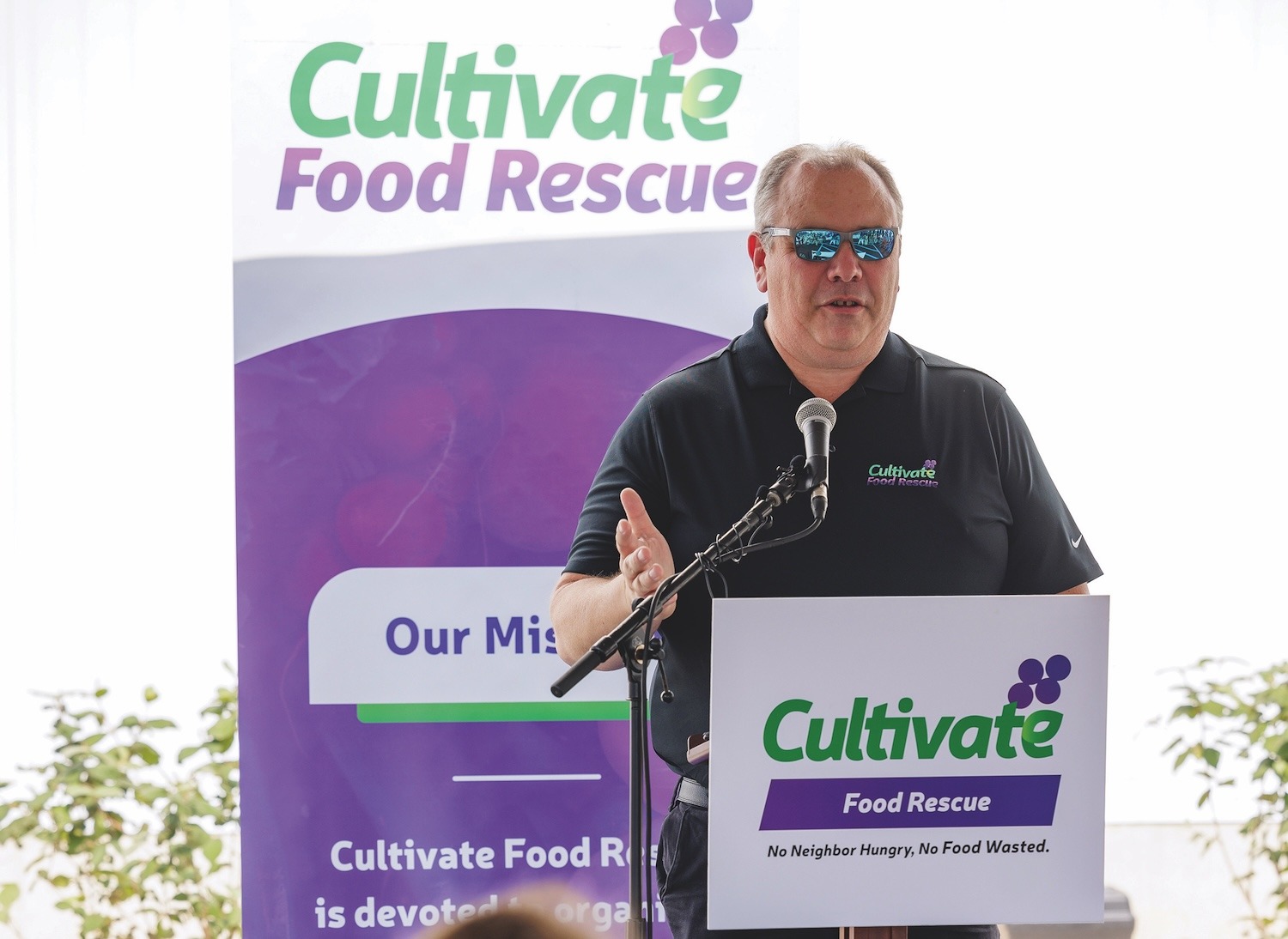
Jim Conklin ’96 founded Cultivate Food Rescue in 2016 to feed hungry people in the South Bend/Plymouth/Elkhart, Indiana, area and reduce food waste. In the 10 years since, he has built an organization of 30 full-time employees and seven part-timers who have distributed more than 15 million pounds of food that might have otherwise gone to waste, raised more than $5 million, and motivated 6,500 people to volunteer to feed their neighbors.
The seed for this nonprofit was planted roughly 20 years earlier, when Conklin was a Butler Accounting student doing an internship with Indianapolis Public Schools. At the time, he was mentoring a student—“I still remember his face today”—who opened up about his food insecurity.
“I didn’t come from a ton of wealth, but we always had food and we were safe,” says Conklin. “So, hearing what that child experienced was very substantial. I didn’t know how important that was at the time, but when I look back, it was foundational”
But first, Conklin had school to finish and a career to pursue. Motivated by professors such as Harry Hicks and internships at Allison Transmission and car auction company ADESA, Conklin started in commercial banking, then began studying to become a Chief Financial Officer.
Then, in 2010, he was diagnosed with a “sizable” brain tumor. He has subsequently undergone five surgeries and five radiation treatments—the most recent in late January. Today, his recovery is going very well, he says.
Faith guided him through. It also caused him to ask: Do I really want to be a CFO, or can I do something to help the community?
The answer took a few years to materialize. In 2013, Conklin was hired by Headsight Inc. (now called Precision Planting), an agricultural technology company in Bremen, Indiana, and a dream opportunity for him. Headsight’s owners, Rich and Samantha Gramm, “had a very positive impact on my faith and generosity,” Conklin says.
The Gramms also owned some side ventures, including a restaurant that was struggling. Conklin suggested closing it; the Gramms countered that Conklin and the restaurant’s chef, Randy Ziolkowski, should come up with another venture to help the community.
Their first thought was a culinary school, but then they visited Second Helpings, an Indianapolis nonprofit that rescues food that would otherwise be thrown away, prepares it, and delivers it to local nonprofits at no cost.
“The joy on people’s faces was just infectious,” he says. “We walked in there—both the chef and I had been in business for a long time—and we had this overwhelming feeling that they’re doing this very well. On the way back, we agreed, ‘We’ve got to do this.’”
The first place they approached was the University of Notre Dame.
“We thought, we’re going to swing big on this and see if we can get some traction,” Conklin says. “Sustainability is huge for them. Having a positive impact on the community is huge for them. And so, we came along at the perfect time.”
The partnership continues to this day. In 2024, Notre Dame named Cultivate its Sustainability Partner of the Year.
“Seeing members of the local community working side by side with the university to tackle this very difficult challenge was inspiring and attracted me to my current role,” says Geory Kurtzhals, Notre Dame’s Executive Director of Sustainability. “What Jim and his colleagues have achieved in this last decade should be celebrated and elevated. They have developed a model which can—and hopefully will—be duplicated in other places.”
Once Notre Dame was on board, in 2017, Cultivate officially opened its doors. The organization started with its Kids Weekend Backpack Program, which takes rescued food and turns it into nutritious frozen meals that are delivered directly to kids in need to fill the gap on weekends. Cultivate now distributes six meals to over 2,100 students each Friday.
In addition, Cultivate now distributes another 10,000 meals a week through area food pantries and soup kitchens.
Conklin says this growth, these partnerships, and being part of an organization providing sustenance to the community fulfills him.
“It is hard and tiring, but we have made a huge impact,” he says. “We have been able to change the focus to food insecurity in our community, and the community has embraced what we are trying to accomplish and, most importantly, who we are trying to help.”