

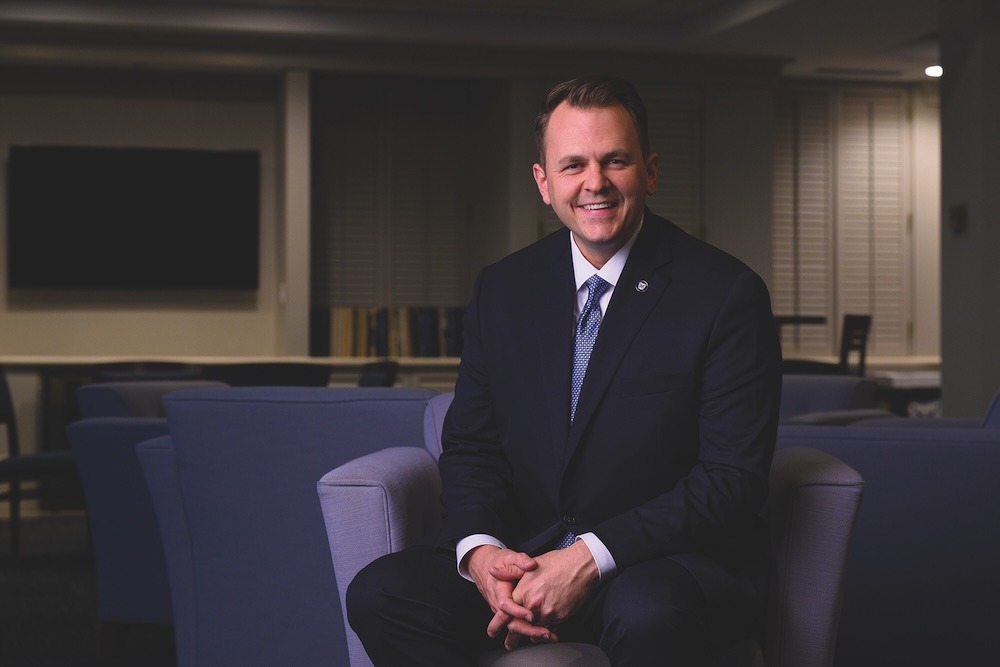
As Michael Hole prepares to return to Butler, he brings with him a career that defies easy categorization. A physician, professor, entrepreneur, and officer in the U.S. Air Force, Hole’s path spans rural Indiana roots to national service at the highest levels of government, including his role as Senior Advisor for Rural America at the White House.
From caring for incarcerated youth and underserved families to helping lead federal efforts that drove a historic decline in overdose deaths, Hole’s work has consistently focused on expanding opportunity and improving lives. A prolific scholar and educator, he has also built and supported organizations aimed at economic mobility, public health, and community resilience.
In this Q&A, Hole reflects on the experiences that shaped his approach to leadership, service, and innovation—and what he hopes to bring to the next chapter at his alma mater.
Q: What’s a story you tell people when they ask what Butler is really like?
It’s about something that happened when I was a junior.
I went to Professor Bob Pribush and said I wanted to help build a school in Uganda for children without access to education. Walking into his office, I half-expected him to say, “Focus on your coursework.” But he didn’t. He said my idea sounded important and asked how he could help.
Over the next couple of years, with support from classmates, faculty, staff, and community partners, we all got to work and built that school together. It was my first real lesson in leadership—in setting a vision, rallying people around a cause, raising money, and delivering lasting results that we could measure. Every year since 2009, 300 students have attended that school in Uganda.
That’s what Butler’s really like. We know that the world’s problems are too big, too urgent. We don’t ask students to delay addressing them until they have diplomas or titles. We ask them to act now to serve the greater good, to have a meaningful impact on people’s lives.
Q: What kind of leader do you hope to be at Butler?
A leader who makes this very special place even better than I found it.
I’m from a small, beloved town in rural Indiana. I was a first-generation college student raised by wonderful parents, and I didn’t fully understand what was possible for me. Butler opened doors and changed everything. So, when I think about leadership, I start there: with the weight of what this University means to so many people. Coming back to serve this place that changed my life is a mission and deeply personal.
I aim to be a collaborative leader, one who asks questions more often than I give answers. Throughout my career, I learned repeatedly that the people closest to a challenge are often closest to its solution. My role is to listen carefully, bring people together, and help align our strengths to accomplish things that matter.
Q: When you were announced as Butler’s next Provost, you said, “Tough minds. Tender hearts. Let’s get to work.” Elaborate on what that means to you and how it applies to the Butler community.
When I say, “tough minds,” I’m talking about competence. Rigorous academics. A real commitment to excellence. The willingness to ask hard questions, work through complex problems, and pursue the truth, even when it’s uncomfortable.
But that’s never been Butler’s whole story.
“Tender hearts” means we care—for one another and for the communities we serve. It means using what we learn to help people who need us.
I learned that from my parents. As a boy, I’d go with them into the homes of elderly neighbors who were dying. I mostly watched. They’d cook meals, help with baths, fetch medications, and sometimes just sit and listen. They protected their neighbors’ dignity. I learned from them that compassion is about showing up, especially when it’s hard.
Tough minds without tender hearts can do harm. Tender hearts without tough minds can fall short. To take on the world’s hardest problems, we need leaders who have both.
Q: How would you say your unique and broad professional experience has prepared you for this new role?
My career has never followed a straight line. And I’ve come to believe that’s exactly the point.
I’m a professor. Teaching, mentoring, and scholarship aren’t abstractions for me—they’re my everyday life. I care deeply about academic excellence and about supporting the people who make it possible.
At the same time, much of my work has been across sectors: health care, business, government, nonprofits, and the military. The toughest problems don’t fit neatly inside one discipline or industry. They require collaboration. They require people who can translate between worlds—who can bring a researcher, a CEO, and a policymaker into the same room and help them understand one another and move forward.
Leading diverse teams to solve hard problems in fast-changing environments and finding ways to move forward—that’s been my career. And that’s what I hope to bring here. Not a rigid agenda, but the instincts to help Butler write its next great chapter, boldly and together.
Q: You’ve talked a lot about your life-changing trip to Ecuador when you were a student. What other experiences at Butler helped shape your professional journey?
The through-line of my career—how I learned to navigate medicine, business, and government—leads back to Butler.
Early in my medical career, I cared for children in homeless shelters whose symptoms rarely fit together neatly. Some causes were medical, others environmental, still others tangled up in everything the kids’ families had endured. My Butler science courses had trained me to follow the data rather than the easiest explanation. That discipline made all the difference.
But I kept hitting a wall. Getting the diagnosis right wasn’t solving the problem. Many of my patients faced challenges no prescription could fix. So, I went back to something else Butler had taught me: how to bring people together around a shared mission. As a student, I’d started a couple of organizations on campus, figuring out how to lead people toward a goal nobody had mapped out yet. I drew on that experience at Butler as I later built programs delivering food, health care, and economic support to families across the country.
With service at the federal level, I sought to reach even more people. At the White House, I relied every day on lessons from Butler’s humanities courses: how to write and speak clearly, distill complexity into something actionable, weigh ethical tradeoffs, and hold competing truths without oversimplifying.
Butler had prepared me for every step. And when I felt unprepared, it gave me mentors to close the gap, sometimes decades after I’d graduated.
Q: What do you see as Butler’s unique strengths?
I’ve thought about this question a lot—as a student, alum, and trustee, and as someone now coming home to serve. Many things set Butler apart, and I’ve had the privilege of experiencing several of them firsthand.
First, our liberal arts foundation has never been more relevant. Today’s technology can generate massive amounts of information instantly. Butler has a duty to cultivate in students the habits of mind that can analyze, harness, and then use that information wisely. Critical thinking. Ethical reasoning. Clear communication. A global and historical perspective.
Second, Butler is embedded in a rare natural and civic space. Students can learn on a fun, park-like campus in the morning and apply what they’ve learned that same afternoon across Indianapolis. Internships, research partnerships, service opportunities, arts, sports, healthcare, business, government. Butler’s community is directly connected to all of it.
Third, Butler occupies a sweet spot of scale: large enough to carry a nationally recognized name and broad academic ambition, yet small enough to remain nimble. Innovation is part of our culture. When Butler decides to move, we actually can move—and that matters more than ever as higher education evolves.
Finally, there’s the Butler Way: relationship-rich and service-oriented. Students and faculty really know one another. Bulldogs everywhere care about their communities. In an increasingly fragmented nation and world, Butler draws people to feel connected and to do something larger than themselves. In this moment, that may be our greatest competitive advantage.
Q: What are the top priorities you have for Butler that can be accomplished through this role?
I’m not coming in with all the answers. My first priority is to listen—really listen—to anyone who loves Butler. The best plans we will build together. But a few things are already taking shape in my mind.
First, as AI reshapes workforce needs, we must cultivate the distinctly human capacities that technology cannot replace. This means Butler’s liberal arts strengths become more, not less, valuable. I’m eager to partner with faculty to ask hard questions about how best to serve students in an AI age, imagining new possibilities for teaching and scholarship, and making learning more personalized, flexible, and cross-disciplinary.
Second, hands-on learning has never mattered more. Butler’s strategy to make experiential learning a core element of the curriculum for all students is vital to how we prepare them for the future. As part of this work, I’d like to see us extend the classroom even further into our communities. More internships. More co-ops. More local and global partnerships. I envision Butler classrooms inside workplaces, turning up the volume on industry integration and collaboration. When learning connects to real problems and real people, students carry lessons for life.
Third, none of this works unless people know they belong. Students, faculty, and staff must feel supported, included, and valued to do their best work. We should continue strengthening our relationship-rich culture and support for mental and physical health so everyone at Butler can thrive.
Fourth, I want more Bulldogs to fall in love with Indiana. There is enormous opportunity here. Let’s make it easier for students and employees to experience and contribute to our state’s future.
And I hope we ask more often what Butler can do for our country and world. Public service and civic learning will be priorities. Because when students are close to pressing challenges while in school, they’re more likely to spend their lives helping to address them.
Q: How will you stay connected to the daily academic life of students and faculty?
By showing up consistently.
As a physician, I learned that trust grows when you leave the office and go where people actually are. I’ve treated patients in shelters, food pantries, and prisons
for years. When I showed up, trust deepened and people got better. That lesson has stayed with me.
I plan to be a provost-on-the-move, visible in the daily life of our University. So, you’ll find me in classrooms and dining halls, at performances and games, in student meetings and late-night study sessions. Not to supervise, but to listen and better understand what it’s like to teach and learn at Butler now.
But showing up is only half of it. I also want people to feel comfortable coming to me—and having lots of ways to do that. I want students, faculty, and staff to raise ideas or concerns knowing they’ll be taken seriously, and that there will be follow-through. Starting this fall, I plan to regularly host an open forum in Atherton Union. No agenda, just conversation.
I’m fired up to partner with the community that makes Butler so special—and to discover just how far we can go.